
The 12th Century
The Middle Ages

The world in the 12th century
The 12th century was a time of big changes in world history. After the fall of the Roman Empire in Western Europe in the 5th century, the wealth and power of Europe had been based in the surviving Eastern Roman Empire, centred in the city of Constantinople (modern-day Istanbul, in Turkey).
But by the 1100s, kingdoms like England, France, Spain and Portugal were growing much stronger, safer and wealthier. Power was shifting back to Western Europe again.
The rest of the world boasted some impressive rulers too. In the Middle East, the powerful Seljuk Empire controlled vast lands (across modern-day Iran, Iraq and Turkey), while in East Asia, the wealthy Song Dynasty in China was famous for creating amazing technology, art and printing systems.
It was during these changing times – while knights, emperors and dynasties ruled across the world – that a small priory was founded in Essex …

A Shocking Royal Quarrel: This 800-year-old painting shows the famous murder of Archbishop of Canterbury, Thomas Becket, by four of King Henry II’s knights in 1170. Notice the brave monk trying to protect him.
The murder happened around the same time the first buildings of Blackmore Priory were constructed.
(Image source: The Martyrdom of Thomas Becket, Psalter (c.1200), Harley MS 5102, f. 32. © The British Library Board)
What do you think motivated the Samford family to found a priory in Blackmore?

Blackmore in the 12th century
The foundation of Blackmore Priory

Fingrith Hall’s entry in the Domesday Book (1086). The Domesday Book is England’s earliest public record. It is a register of who owned the land throughout England. (Click to enlarge the image.)
(Used by permission of Prof John Palmer, George Slater and opendomesday.org, licence CC BY-SA 3.0)
We don’t know exactly when Blackmore was founded. Our village isn’t directly mentioned in William the Conqueror’s Domesday Book of 1086, but the nearby manor of Fingrith was recorded. That record likely also included information about anyone who lived around the present-day location of ‘Blackmore’.
When more specific records began to emerge in the Middle Ages, the village is often called ‘Blakemore’. The name probably comes from the Anglo-Saxon words ‘blæc’ and ‘mór’, meaning a swamp or forest clearing with dark soil.
Around the year 1160, Adam and Jordan de Samford – the owners of Fingrith Hall – donated land and received permission from Richard de Belmeis, the Bishop of London, to build a priory. The first buildings of Blackmore Priory were constructed around 1170. The existing wall at the west of the church (the wall containing the doorway to the tower) was built around this time. Before the tower was built (c.1400), this doorway was used as the main entrance for people entering the church to worship.
Churches were often built on the remains of pre-Christian religious sites. This is another reason for believing there were buildings in Blackmore before the foundation of the Priory. But it was after the foundation of the Priory that Blackmore grew in importance.
At its foundation, Blackmore Priory was home to one prior and twelve canons. They were members of the Augustinian Order. They weren’t monks; each was an ordained priest, living in the priory during the week and serving in local parishes on Sundays.
Blackmore provided the priest for nearby parishes, such as Margaretting, Willingale and Stondon Massey, as well as parishes much further away, like Tyburn in Middlesex and Great Hormead in Hertfordshire.
The canons would have had servants to help them with the work around the priory. Servants would have worked in the priory kitchen and bakery, helped with farming and would have run inns to accommodate the priory’s visitors. In the priory’s early years, the majority of the houses in Church Street would have operated as inns.
Being within a day’s journey from London, the priory attracted many visitors. Visitors may have been stopping overnight on long journeys, or they might have come to Blackmore on pilgrimage. Those on pilgrimage may have been sick or experiencing a particular worry in their lives. Some may have come simply for a rest or ‘retreat’ from their demanding lives in London. Pilgrims came to Blackmore to seek God and to receive prayer from the prior and canons.
What do you do or where do you go when you’re worried about something?
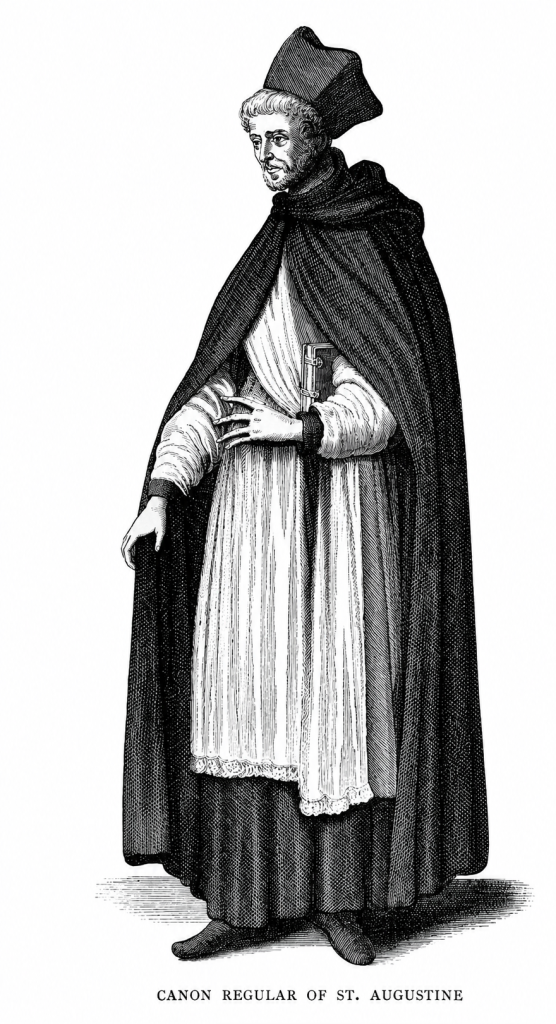
An illustration of an Augustinian canon. They’re known as ‘black canons’ because of their black-coloured robes (known as habits)
(Image from English Monastic Life (1904), F A Gasquet osb)
Prior Roger
A video message from Prior Roger will be coming soon!